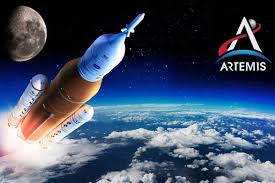
For the first time in more than half a century, NASA is preparing to send astronauts past Earth’s orbit and back to the Moon. As soon as 2026, NASA plans to launch Artemis II, the first crewed mission of the Artemis program, sending four astronauts on an approximately 10 day, 685,000 mile journey around the Moon and back to Earth. The mission marks what NASA refers to as “a golden age of exploration and innovation” signaling the beginning of a new era in deep space travel under the broader Artemis campaign.
It was 1969 when Apollo 11 first landed astronauts on the lunar surface, becoming one of humanity’s greatest achievements. After repeated Apollo missions expanded scientific knowledge and proved the technology’s capability, crewed lunar exploration ended with Apollo 17 in 1972. For more than five decades, no human has traveled beyond low Earth orbit. Artemis II is set to change that, picking up humanity’s journey where Apollo left off, but using entirely new systems designed for long term deep space exploration.
The decade-long pause after Apollo reflected more than technological limits. Astronomy Club president Yogya Nimmala suggested it stemmed from shifting opinions and funding concerns.
“I think there were a lot of factors that went into it, mainly because a lot of people think space exploration isn’t a main priority, and I do understand why that’s valid, like why are we trying to go outside of the planet when there’s so many issues in the planet itself. And I think because of that, being added on to public opposition, it can cause some issues, and funding is a huge thing, especially now there’s been lots of budget cuts that NASA’s been facing, and that severely hinders things.” said Nimmala.
Unlike Apollo missions that landed crews on the Moon, Artemis II will focus on testing the systems that will make future landings possible. The astronauts will travel about 4,700 miles beyond the Moon’s far side, farther than any human has traveled from Earth, before gravity pulls them home. The spacecraft will reenter Earth’s atmosphere at nearly 30 times the speed of sound before splashing down in the Pacific Ocean. The astronauts will survive using a modified direct atmospheric entry. Orion will plunge into the atmosphere at about 25,000 miles per hour. A reinforced heat shield protects the capsule from temperatures above 5,000 degrees Fahrenheit and adds drag to slow Orion down. Then a carefully sequenced multi-stage parachute system slows the spacecraft for a safe landing.While Artemis builds on Apollo’s legacy, it does so with significantly improved technology.
Nimmala shared another way modern spaceflight has become more practical. “They’ve been developing rockets we don’t have to keep disposing of, it’s more efficient and resource friendly, which I feel would improve public opinion.” Her thoughts reflect how innovation is not just about accomplishing more, but about doing it sustainably.
The roughly 10 day voyage will serve as the first crewed test of NASA’s new deep space transportation system: the Orion spacecraft, the Space Launch System (SLS), and upgraded exploration ground systems. Before committing to the lunar flyby, the crew will perform two large circles around Earth to test life support systems, navigation, propulsion, and manual control capabilities. During one orbit, astronauts will take control of Orion for about two hours, practicing flight maneuvers while mission control monitors their performance from Houston.
A primary objective of the mission is to test Orion’s environmental control and life support systems in deep space, ensuring astronauts can live and work safely beyond low Earth orbit. Engineers will analyze every phase of the flight, just as they did with Artemis I, which traveled over 1.4 million miles to test spacecraft systems. NASA officials have stated that lessons learned from Artemis give them confidence that Artemis II’s SLS rocket and Orion spacecraft will be “the most capable deep space system ever flown.”
While the technology is promising, Artemis has also seen delays. The Space Launch System has faced technical adjustments and schedule changes, drawing criticism about the cost and timing of the project. Nimmala said, “I know there’s been issues with the SLS and whatnot, like it’s being rolled back, but I wish them luck and I hope it goes well.”
Artemis II also serves as a science mission. The crew will act as both explorers and research subjects, gathering critical data about how the human body reacts to deep space. Astronauts will wear biometric devices to monitor sleep, stress, cognition, and teamwork through studies like ARHeR, Artemis Research for Crew Health and Readiness. Other studies will analyze immune responses through saliva samples, test radiation exposure using active sensors inside Orion, and use organ-on-a-chip technology beyond low Earth orbit for the first time. This data will help NASA develop countermeasures for future lunar missions and eventual journeys to Mars.
Despite debates over budget, Artemis II has built significant public excitement. When asked how she feels about NASA returning to the Moon, Nimmala answered, “I’m actually really excited for the Artemis missions because one of the astronauts, Christina, is from North Carolina, and I love the representation. I’m very excited we are going back to the Moon after such a long time.” Her response shows excitement for the renewal of space exploration programs.
The crew will also conduct a lunar observations campaign, documenting the Moon’s surface through photographs and audio recordings. As the first humans to see the lunar surface up close since 1972, they may observe areas of the far side never directly seen by human eyes. A dedicated science officer in mission control at Houston will coordinate real time lunar science analysis during the flyby, marking the first integration of science flight control operations for an Artemis mission.
The four astronauts selected for Artemis II, Reid Wiseman, Victor Glover, Christina Koch, and Jeremy Hansen, bring experience, leadership, and international partnership to the mission. Wiseman will command the mission. Glover, the mission’s pilot, is a decorated naval aviator and has previously flown to the International Space Station with SpaceX. Koch, who holds the record for the longest single spaceflight by a woman and is an alumna of NC State, will serve as mission specialist, bringing extensive spaceflight experience. Hansen, representing the Canadian Space Agency, will also serve as a mission specialist and plays a significant role in establishing global partnership behind the Artemis program.
The composition of the crew demonstrates the diversity and international cooperation on which the Artemis program is built, marking a distinction from the all American Apollo crews. Artemis is not just about revisiting the Moon, it is about building toward a sustained human presence. The technology, experience, and partnerships that Artemis produces will lay the groundwork for more lunar activity, scientific discovery, and increasingly ambitious goals, including sending humans to Mars.
NASA describes Artemis not as a brief return to the Moon, but as the beginning of a sustained presence, especially in the lunar south pole, a region believed to contain water ice that could support future astronauts and infrastructure. Artemis is a stepping stone to a lasting human presence on the Moon. The technology, experience, and partnerships this mission creates will contribute to future lunar landings, scientific discoveries, and other milestones humanity has yet to reach.
Nimmala agrees and believes space exploration should not have paused for so long. When asked what she hopes to see from the mission long term, she answered, “I think going back to the Moon is a good thing because I don’t want us to stop like we had for so long, I want us to keep building toward a really cool future where we can do more than just orbit or circle the Moon, and I think this is a good first step to take toward that.”
If all goes as planned, Artemis II will launch in February or March 2026. More than a milestone, the mission represents a bridge between past and future, continuing Apollo’s legacy while advancing science, technology, and global cooperation. It marks a new era not only for NASA but for space exploration globally, another step for humanity into a new age of discovery, where humans venture into deep space not as visitors, but as pioneers preparing to stay.
Heres some extra info
https://www.nasa.gov/wp-content/uploads/2026/01/a2-reference-guide-012825.pdf?emrc=6996fdaca2beb