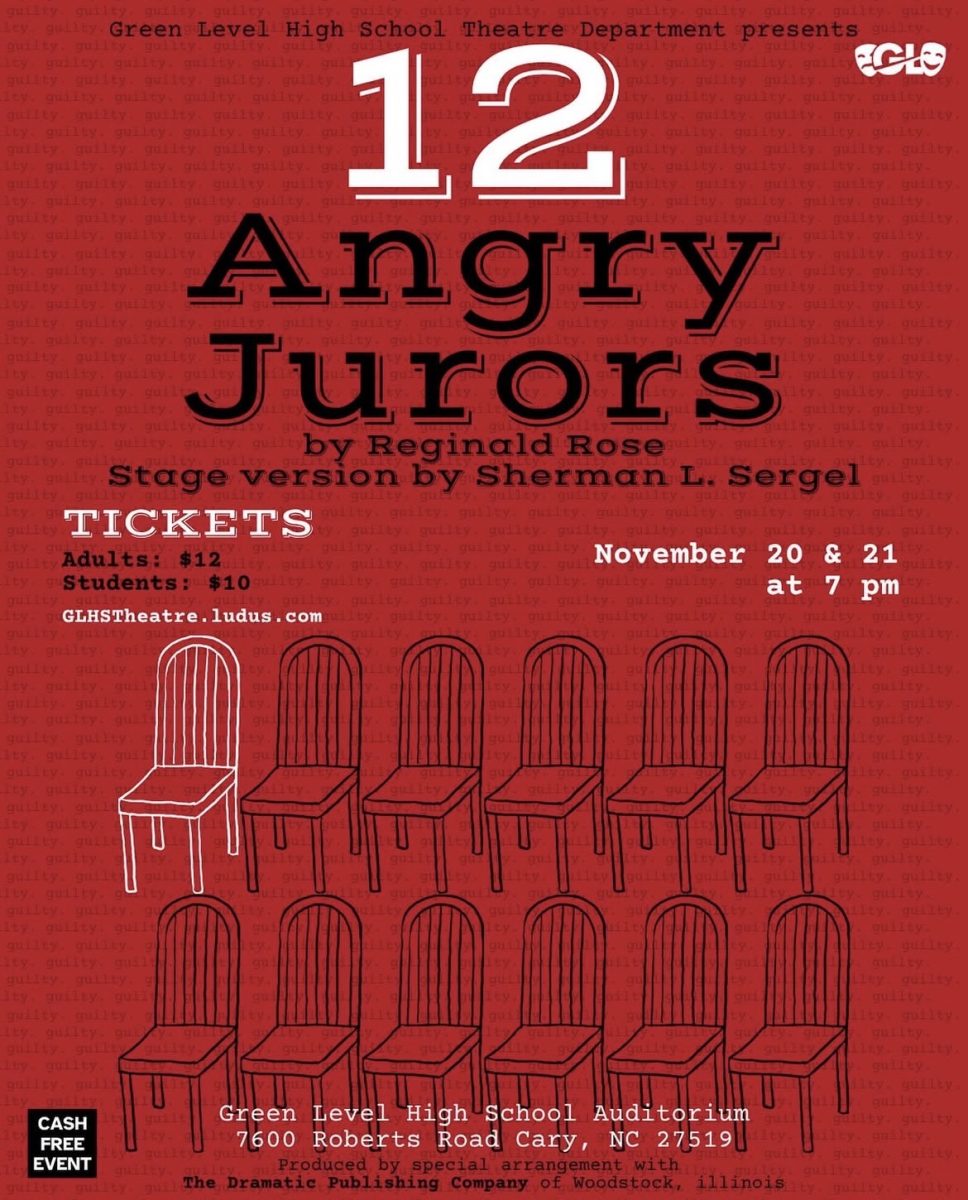
The Green Level Theatre III Honors class will perform their fall production, 12 Angry Jurors, next weekend on November 20-21. The play follows twelve jurors who must decide whether a teenage boy is guilty of murder. As they argue over the verdict, tensions rise and arguments break out, showing just how much bias and emotion can affect how justice is served.
Theatre teacher Rebecca Craig chose the play because it gives her students a chance to really focus on acting.
“It’s a character-driven drama,” Craig said. “It gives students the opportunity to dive deeply into their character’s tactics and motivations. It’s really built for a classroom setting much more than an after school production setting because of that element. In general, dramas tend to either be plot-driven or character-driven and I wanted something that would give students a chance to really get to know their character.”
Because the Honors III class has twenty-two students, the show is double cast, with two actors sharing each role.
“As you are trying to figure out how your character would respond to something, or how they would approach something, you have someone else to collaborate with,” Ms. Craig says. “You’re able to take your own interpretation onto the stage with your peers, and I think that piece has really helped the class feel connected as a whole.”
Junior Ainsley Monohan will be playing Juror 8, the calm, compassionate juror who stands up for what she believes is right, even when everyone else disagrees.
“Juror 8 wants to know all the details and asks a lot of questions,” Ainsley said. “It’s hard for me to stay as calm as she is, since I’m usually more reactive on stage.”
Junior Caleb Johnson plays Juror 3, the main antagonist of the story. “He’s very power-driven and full of anger,” Caleb said. “The hardest part is having everyone else against me—it’s difficult to play the character no one likes.”
Both Monohan and Johnson agreed that the most interesting part of rehearsals has been the blocking, which in theatre means figuring out exactly where and how actors move on stage.
“We’re doing the blocking separate from the line throughs, so it’s really interesting seeing how we finally combine all the pieces and watch everything come together,” Monohan said.
Ms. Craig said this kind of dialogue-heavy show helps students learn how to stay focused and react naturally on stage.
“Acting is about reacting,” she said. “You can’t plan out every single action or reaction, because sometimes there’s a slight change in tone, or their body is turned a different way. And so students learn how to be present and how to act, not just when they’re speaking, but between those moments.”
In the end, Ms. Craig hopes the play reminds audiences how powerful a single voice can be.
“Everyone in that room, regardless of how much they say, has something valuable to share,” she said. “I want people to remember that their voice, whether it’s big or small, carries an impact.”